

Sejong City: South Korea’s Administrative Capital Faces Real-Life Challenges
“She’s the fifth person I know to leave this year – and it’s only the beginning of March,” I thought glumly, trudging along my way home. I, a fourteen-year-old living in Sejong Special Self-Governing City, had just heard the news that my friend Gina was moving to Seoul in a few days. She wasn’t the only one leaving the city. More and more families were moving out of Sejong. Some were heading to Seoul, others to nearby big cities like Daejeon. The number of departures seemed to increase each year.
It wasn’t always like this, though. My mind shifted to elementary school when my school had to make a whole new class to accommodate new students. That was barely four years ago. But now, people seemed to be moving out just as quickly as they had arrived. Why was that? What problems did Sejong have in attracting the population of Seoul and retaining its own?
To understand Sejong, we must go back to why it was built. The drastic population growth of Seoul began in the 1970s, coinciding with rapid economic development. Seoul’s overpopulation led to skyrocketing house prices, pollution, the overuse of resources, as well as the growing gap in wealth and standard of living between Seoul and other provincial areas. Government officials sought to solve the problem by creating a new administrative capital. This was first suggested by former president Kim Dae-jung in 1971. Despite some skepticism, many presidents supported separating the economic and the administrative capital throughout the years, regardless of their political stance.
After overcoming constitutional challenges and a year-long legal battle, relocating the administrative capital to the Chungcheong area was ultimately approved. Named after the Great King Sejong of the late Joseon Dynasty, the new capital Sejong Special Self-Governing City officially launched on July 1st, 2012. As of 2024, 45 central government agencies, 16 national research institutes, and 10 public institutions have been repositioned to Sejong.
During the development process, many of the city’s characteristics were adopted from the winning proposal of a conceptual design competition open to architects. The winning design incorporated abstract concepts like democracy and equality, which were actualized by a “decentralized” city layout. The city’s layout featured a ring-shaped system and a set of 25 equally-ranked small towns.
However, despite its bold plan and promising start, Sejong has faced significant controversy, especially regarding whether it has effectively attracted the population from Seoul. Although Sejong had successfully brought in numerous government agencies and research institutes with over fifty thousand employees, only a few have made the city their residence. This brings us to the core issue: Sejong struggles to meet the needs of its residents. If even those working in Sejong choose not to live there, how can the city expect any new residents?
Ironically, it is Sejong's initial goals and intended plans that make the city unfit for living. More specifically, the problem is the lack of proper execution of goals which were far too idealistic. Let’s delve into some of the main problems that residents have with the city.
The Lack of a Central Hub
One core issue Sejong faces is the lack of a “downtown” area. Sejong’s theme of decentralization was implemented by designing the administrative city into a ring-shaped system with no particular central hub, distributing its functions into six living zones. Zones 1 through 6 encircle Zone S, a space left open to preserve the natural environment. As of 2024, more than half of the population resides in Zones 1 and 2. Zone 1, with the Prime Minister’s Office, the Government Complex, and forty-four central administrative agencies, represents central administration. Zone 2, on the other hand, is a place for arts & culture and international commerce. Each of the six zones incorporates unique public facilities that align with their designated themes.
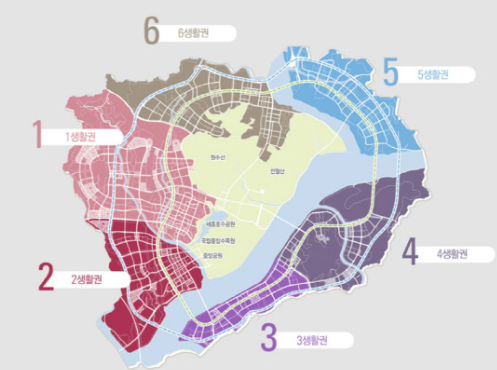
The distribution of governmental buildings across each zone naturally led to the distribution of commercial buildings. While the commercial facilities in each zone are enough to fulfill basic needs, none of them are large enough to develop the bustling downtown atmosphere that most cities have. As a result, residents find it inconvenient to enjoy leisure activities since amenities like movie theaters and shopping malls are spread across multiple zones.
The absence of a focal point in the city also causes the high vacancy rate of commercial properties. According to the Korea Real Estate Agency, as of July 2024, the vacancy rate of commercial buildings in Sejong has reached 25.7%, ranking as the highest in the country. Due to the inconvenience of enjoying leisure activities in Sejong, citizens go to Daejeon or Cheongju to have fun. This has contributed to the decline of Sejong’s commercial area, despite Sejong ranking fifth in the nation for income levels.
Cities naturally develop around a central hub, and a strong hub attracts people from other cities. The absence of such a hub in Sejong makes it more challenging for the city to grow and appeal to new residents.
Inconvenient Transportation
If a city lacks a central hub, it should—at the very least—have extensive and convenient modes of transportation for citizens to travel around zones. However, Sejong has also failed to maintain an efficient transportation system.
Sejong was planned as South Korea’s first-ever public transportation-centered city, with 70% of all transportation to be done via public transportation. However, this goal seems to have largely failed. The time gap between intercity buses is wide and irregular, some even being over thirty minutes. The Bus Rapid Transit (BRT) system, originally initiated as an alternative to subways, also faces the problem of long waiting times. Concerns of inclusivity and accessibility have also been raised with the BRT; some BRT vehicles have platformed floors, making boarding difficult for wheelchair users.
In direct opposition to the initial plan, the many issues with public transportation have made Sejong a city where driving a car is almost a necessity. The Korea Transport Database revealed that, in 2020, 45.4% of transportation within the city was by car while only 7.3% was by city buses, placing Sejong among one of the lowest in the country for the rate of public transportation used.
Even for drivers, the experience is far from ideal, with inconvenient roads being the main reason. Although Sejong’s road coverage is around 24%, comparable to other cities, there are no wide boulevards or large avenues—just narrower roads, mostly four lanes or less, spread evenly across the city. This is because the internal road network of Sejong is designed to be decentralized and non-hierarchical, aligning with the city’s theme of equality and distribution. Excessive traffic control—speed bumps every minute and speed limits changing every block—combined with the two-lane roads cause heavy traffic congestion during rush hours, especially near the Government Complex and City Hall.
An Unfulfilled Aesthetic Vision
Although Sejong City has been very experimental in its architectural design, there has been criticism from residents regarding its aesthetic. This is due to the high-rise apartment buildings surrounding the city, blocking the view.
The initial development guide for the administrative city emphasized harmony with the surrounding landscape. Therefore, regulations on building heights were necessary to preserve the city’s skyline and to maintain a clear view of its significant landmarks. However, these restrictions on the number of stories and the height of buildings only apply in the vicinity of the government complex and along Hanuri Avenue. This results in a contrast where commercial buildings in the area are limited to eight floors, while residential apartment buildings elsewhere are 20 to 30 stories tall. Consequently, Sejong’s skyline, initially intended to be framed by low mountains, is instead dominated by tall apartment buildings, obscuring views of key landmarks. Primary landmarks like the government complex, Millmaru Observatory, and Mount Gyeryong are often difficult to see and only visible up close.
Unlike other new cities primarily built to attract people from Seoul, Sejong carries the unique significance of being Korea’s only administrative city. Sejong set out with ambitious goals as Korea’s administrative capital. With themes of democracy and peace, the city aimed to create something innovative and fresh—a city focused on public transit, built without a central hub, and full of unique architecture you wouldn’t find elsewhere. However, efforts to reinforce the city’s theme have eroded some of Sejong’s functional value. A failure to effectively restrict the heights of buildings has resulted in large amounts of high-story apartment buildings, therefore ruining the city’s aesthetic. The execution of policies without adequate focus on resident convenience has also resulted in discomfort and further population outflow. The decentralized and public transportation-focused nature of Sejong was supposed to be its strength, but it is now a weakness due to its lack of practicality.
Nevertheless, Sejong has the highest happiness rate in Korea and the lowest crime rates per unit of population, making it an attractive place to raise children. These favorable conditions have contributed to Sejong achieving the highest birth rate in the country. The challenge is retaining the rest of its population. In particular, the population of people in their 20s actually decreased in 2023. In South Korea, the number of individuals who choose to live on their own and without children makes up more than 30% of the population. For these individuals, entertainment and convenience take priority over family-oriented environments. With inconvenient transit and a deficiency of entertainment venues, Sejong fails to meet its priorities. This is an obstacle to the city’s efforts to attract and retain residents outside its demographic of young families.
For Sejong to truly prosper, it must address the problems that residents are facing. If Sejong overcomes its challenges, the city can also appeal to child-free couples or one-person households. Creating a more practical environment while maintaining its family-friendly atmosphere and its unique role as an administrative city would bring the city closer to achieving its original goal of redistributing the population of the Seoul metropolitan area. As Sejong continues to grow and evolve, I hope it can one day be recognized as a thriving administrative capital.