

The Game South Korea Was Built to Lose
You only place the opening pattern, step back and watch.
South Korea is a living proof of the game.
In 2025, South Korea recorded a fertility rate of 0.80 children per woman, a slight rise from the record low of 0.72 in 2023, but still barely a third of the 2.1 needed to keep a population stable. Deaths exceeded births by nearly 109,000, the sixth straight year of natural decline. No country at peace has ever fallen this far.
Sources: UN Population Division, KOSIS, Statistics Korea. Made in R Studio.
The usual explanations are familiar: housing costs, private education spending, a labor market that punishes mothers. All real. But all symptoms. Conway’s game points to something deeper: the crisis was not caused by any single policy failure. It was encoded into the grid the moment the country’s initial conditions were set.
The grid was set in the 1960s. When Former President Park Chung-hee launched his Five-Year Plans, South Korea’s GDP per capita was $79. To escape poverty, the government ran one of history’s most aggressive anti-natalist campaigns, on the theory that fewer mouths to feed would free capital for industrial growth. The 1960s slogans urged families to “have few children and bring them up well.” And by 1983, “Two is too many.” Sterilization drives and tax penalties drove the fertility rate from 6.0 to below replacement in 33 years.
But unlike Park’s intentions, fewer children did not lighten the financial burden, as each child now carried the entire weight of a family’s future. South Korea has long valued education, but the new economic model extremized that reverence. Power concentrated in a handful of conglomerates—Samsung, Hyundai, LG—that hired almost exclusively from elite universities. With fewer children to spread the bet, parents poured everything into one path: the Suneung, the SKY universities, the corporate job. Education became a survival strategy, the axis around which society rotated.
That axis pulled the country’s geography apart. The universities, the conglomerates, and the jobs were in Seoul. So, the young followed. Over half the population packed onto 12 percent of the land, while in the countryside, communities began dying of isolation. The term jibangsomyeol, or “regional extinction,” entered common speech: over 100 of 228 municipalities now risk disappearing.
Just like Conway’s rules, this grid kills its cells two ways. In the emptying provinces, too few neighbors: aging villages with no one to replace the young who left. In Seoul, too many: apartments cost fourteen years of an average salary, and a child is a financial bet most young Koreans refuse to place. The old model of communal child-rearing, children raised by the village, vanished with the villages themselves, and the system that sustained large families rested on the overlooked labor of mothers: a bargain that traded women’s careers for the home, and that today’s young women are less willing to take. The government reversed course in 2006, but the rate had already hit 1.08; the pattern was locked.
Yet that 0.80, up from 0.72 in 2023, has been read as recovery, making hopeful headlines. But Conway’s game has a name for this kind of hope: the blinker, three cells that flip back and forth forever. South Korea’s numbers work the same way: the 2025 rise reflects a bigger cohort born in the early 1990s passing through peak childbearing age, combined with post-COVID marriage catch-ups. Once that window closes, the pattern resets.
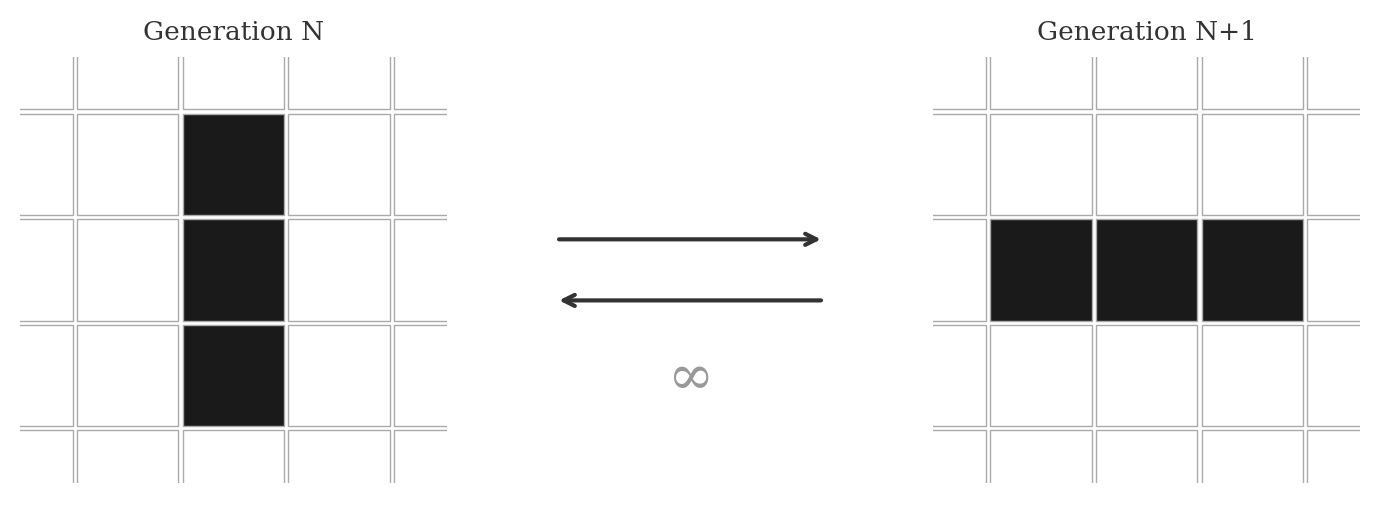
Courtesy of LifeWiki. Made in R Studio.
Since 2006, the government has spent an estimated 280 trillion won on pro-natalist policies: cash bonuses, parental leave, housing subsidies. However, research by Hugo Jales found that over 74 percent of that spending goes to births that would have happened regardless.
Breaking the pattern, then, will not come from more cash. It would require changes the policy has never attempted: an education system that no longer collapses childhood into preparation for a single exam, a labor market that does not force women to choose between career and motherhood, and a geography that gives young people reason to build lives beyond Seoul, so the grid is no longer split between cells dying of isolation and cells suffocating from density.
Until those changes, the cells will keep dying, one generation at a time. But do not blame them, they are just following the logic of the game: a logic that was written into the grid before most of today’s young Koreans were even born.