
48 Hours on Fake Dopamine
‘Your order has arrived.’ My phone said so just before midnight on a Wednesday, and my phone was lying. Nothing had arrived. Nothing had been cooked, paid for, or carried to me. I had spent eleven minutes choosing fried chicken, filled a cart, pressed the button and watched a courier cross a map, and every step of it was fake. I went to sleep less hungry anyway.
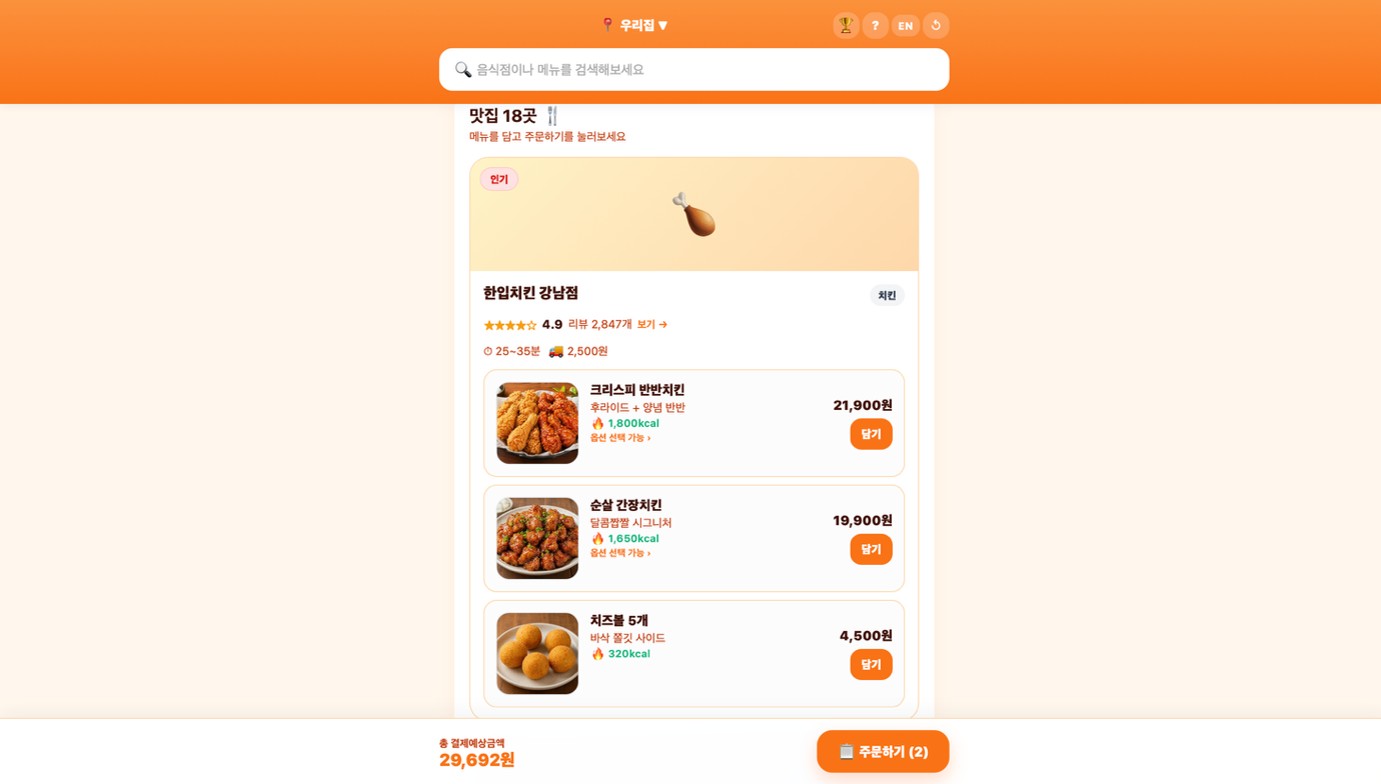
For two months I had been reading about these “dopamine sites”: web pages that reproduce the routines of spending with everything left in except the buying. If you have ever filled an online cart and closed the tab before paying, you already understand most of it. The best known spoofs Baemin, Korea’s biggest delivery app. Its name, “food never comes” in Korean (음식만안와요), turns a complaint into a promise: only the food does not come. Another is built around damta (담타), short for “cigarette time,” the office smoke break. In April, Money Today reported that the smoke-break site alone drew about 30,000 visitors a day; by early summer the story had reached The Times of London and Psychology Today. That number was what caught me: not that the sites existed, but that so many had decided a break that gives them nothing was worth taking.
So, I gave the trend two days of my life. The rule: from Wednesday to Friday night, every craving had to go through a fake version before a real one. I wrote down every visit. I spent around five hours on the different websites, four in total: nine fake orders, five virtual cigarettes. Nothing bought. Around it, just an ordinary week: morning shifts at my university office, evenings studying in a cafe, iced americanos in between.
The fake app is as complete as the real one: menus carry ratings, reviews and delivery times, and the address field is optional. I compared two chicken places, chose the one rated 4.9 stars, and added cold buckwheat noodles (naengmyeon, 냉면) on the side. While the courier icon crossed the map, I felt the same small lift a real order gives. Not a real pleasure but more like anticipation: attention narrowing onto something good that is on its way. Then came the effect that explains why people keep coming back. As soon as I ordered, I felt less hungry. I was also happy about the unspent money. Not relieved. Happy, as if I had actually earned it.
The fake smoke-break site is simpler. Click the cigarette and it lights. Hold the filter down and it burns faster. I have never smoked, yet I took five three-minute breaks anyway, in themed rooms: an office rooftop, a university gate, outer space, a room of silence. A counter shows how many strangers are on break with you. During my second cigarette, someone in the chat complained about a manager. Someone answered, “Me too.” A third: “Me too.” I felt less alone, which I had not expected, since I was alone, in a cafe, watching an animation of a cigarette burn.
None of this was an experiment in any strict sense: one person, two days, no control condition, nothing measured beyond what I noticed and wrote down. My hunger and my comfort were feelings I reported, not data, and since I have never smoked, nothing I felt at the smoke-break site can speak for someone who does. The pattern itself, though, is well documented by people working with rather more than a sample of one.
Dopamine, the chemical the sites are named after, has more to do with wanting than with having. A 2001 brain-imaging study by Brian Knutson and colleagues found the brain’s reward system firing hardest while people waited for a payoff, not when they received it. My chicken order ran that course: a cue, the app icon at midnight; then the wanting, eleven minutes of menus and ratings; then the button meant to settle it. In real life a fourth step follows: the food, the bill, the full stomach. The sites give you the first three and remove the last one.
My missing hunger has an explanation too. In 2010, researchers at Carnegie Mellon University reported in Science that people who imagined eating a food, bite by bite, ate less of it afterward, not because they liked it less, but because they wanted it less. “The anticipation often generates a psychological reward equal to, or sometimes greater than, the actual purchase,” the media psychologist Pamela Rutledge wrote in Psychology Today. Even the receipt was part of it: a record of what I had not spent, a small reward for not buying.
By Thursday night it was less an experiment than a new habit. I filled carts without appetite, wanting the filling more than the food. Through other people’s posts I found more of these sites, including a fake mall selling impossible things; I stayed too long in the reviews of a ten-million-won (about $7,000) time machine. Meanwhile, my friends had booked a real dinner for Friday. The comfort was real too, but each visit delivered a little less of it. Rutledge warns that such simulations help when they add to a life and cost us when they replace it. Critics call them a kind of scrolling: a short break that fixes nothing. “This is an era of uncertainty about the future and heavy emotional strain,” Kim Heon-sik, an adjunct professor at Jungwon University, told the Hankook Ilbo. “People now find comfort in the very state of being loosely connected online.”
So, should we worry about a generation ordering food that never comes? Not about the sites: they offer a free break that works and fixes nothing, which is what breaks are for. What is worth watching is the line Rutledge draws: whether these rituals are added to a life or quietly stand in for one. It is not visible from outside, and in two days I felt it move: by Thursday the fake order came instead of the decision, not before it. When thirty thousand people a day take their rest with strangers in a fake room, that says something about the weight they are carrying. The real question was never whether the fake dopamine works. It is why so many people need it this badly.